
خزن
Store closer. Fulfill faster. Dispatch smarter.
Warehousing companies sell space. WMS vendors sell software. Courier aggregators sell shipping labels. A growing merchant has to assemble all three and carry the integration risk between them. KHAZN is designed as one layer that holds the space, the software and the dispatch together.
- Sector
- Logistics & Commerce Infrastructure
- Category
- Warehousing & Fulfillment Infrastructure
- Primary buyer
- Founder or Head of Operations at a growing commerce business
- Entry wedge
- One urban fulfillment node and a handful of merchants. Prove receiving, picking, packing and multi-carrier dispatch inside one operating layer, then add nodes.
Platform architecture and warehouse operating model defined. Seeking design partners among e-commerce brands, distributors and 3PL operators.
Stage 2 of 6: Product blueprintOne order, from dock to doorstep.
Walk an order through receiving, allocation, picking, packing and carrier selection, and watch the control centre update as it moves.
Loading product concept…
Fulfillment is assembled from parts that were never designed to work together.
Inventory sits too far from demand, warehouse work runs on paper and spreadsheets, and every courier is booked by hand. The cost is not one large failure. It is a hundred small delays that compound as a business grows.
- Inventory too far from demand
- Single-warehouse distribution puts a national delivery promise out of reach.
- Capital before scale
- A merchant must commit to a lease and fit-out long before volume justifies either.
- Disconnected systems
- Inventory, orders, couriers, returns and reporting live in separate tools that do not reconcile.
- Manual dispatch
- Carrier selection and label creation happen by hand, order by order, with no SLA comparison.
The wedge
One urban fulfillment node and a handful of merchants. Prove receiving, picking, packing and multi-carrier dispatch inside one operating layer, then add nodes.
What it is, and what is actually in the first release.
- KHAZN WMS
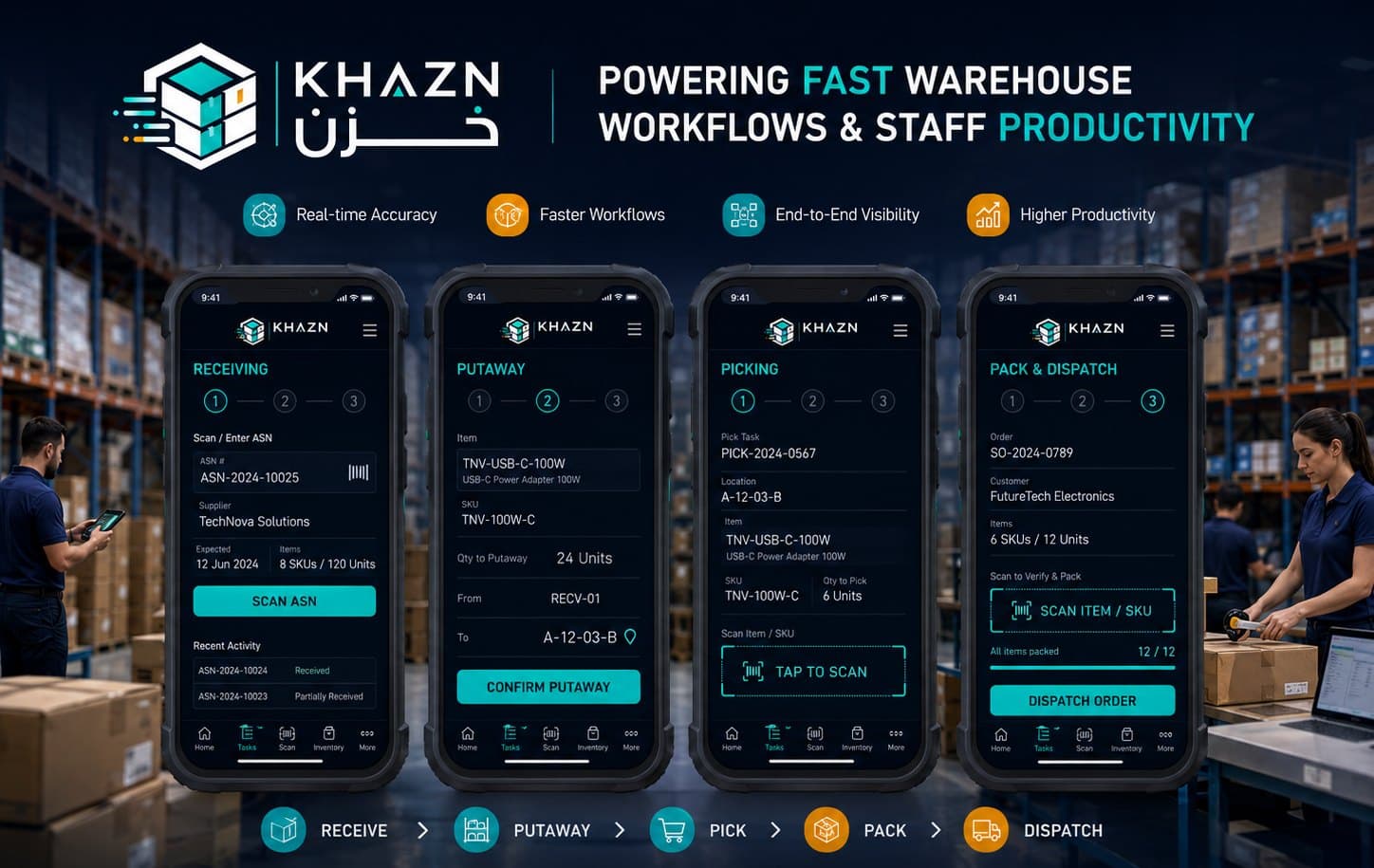
- Multi-warehouse inventory, bins and zones, receiving, put-away, transfers, cycle counts, batch and expiry tracking.
- KHAZN Fulfill
- Order intake and allocation, picking, packing, label generation, dispatch preparation and returns.
- KHAZN Connect
- Commerce, marketplace, ERP and OMS integration with order synchronisation and webhooks.
- KHAZN Dispatch
- Carrier orchestration: selection, labels, tracking numbers, pickup handoff and status synchronisation.
- KHAZN Control
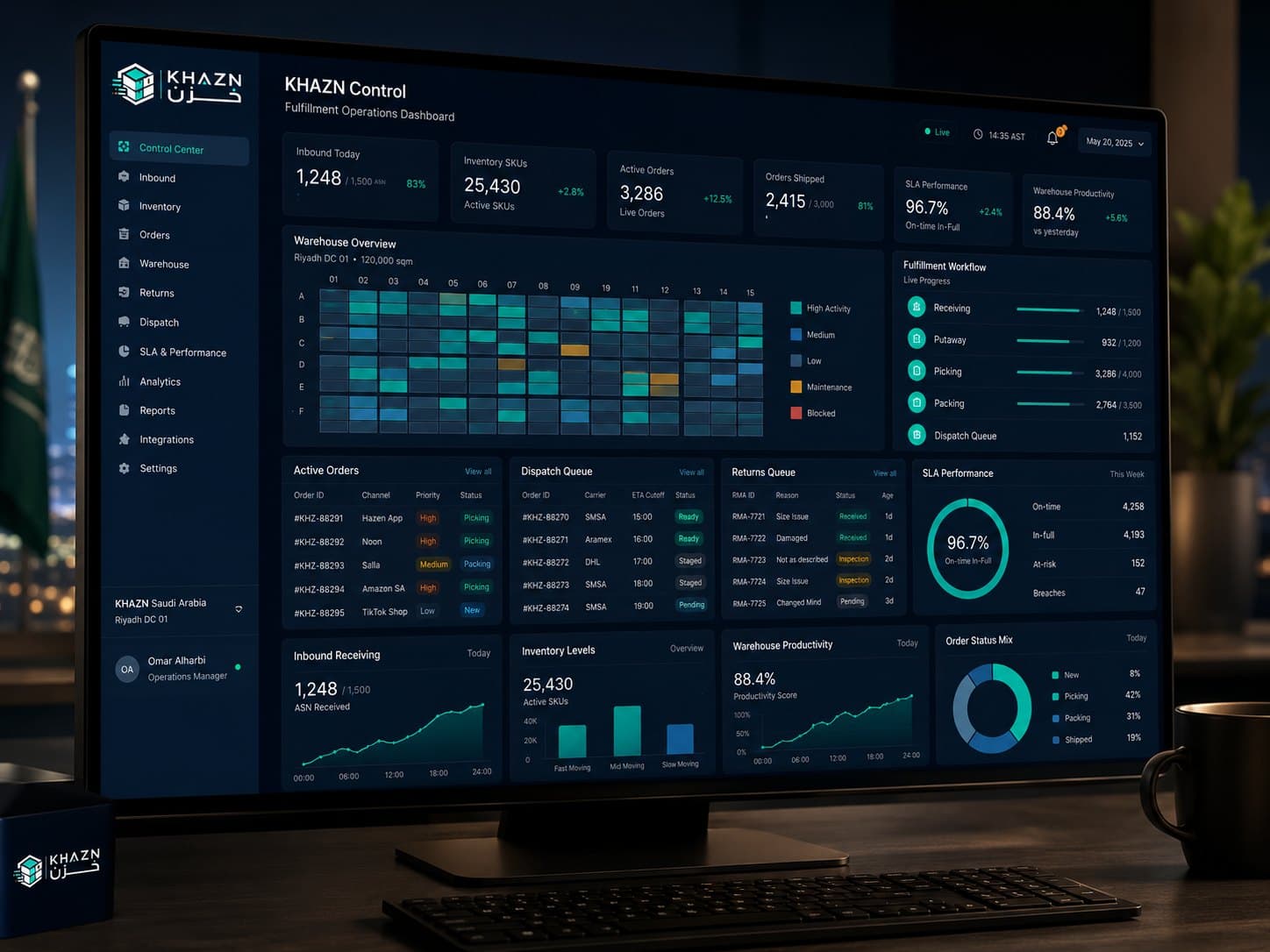
- Operations command centre for live orders, throughput, pending dispatches, capacity and SLA exceptions.
- KHAZN Intelligence
- Inventory velocity, reorder and storage recommendations, fulfillment cost and carrier performance analysis.
In the MVP
Multi-warehouse inventory
One stock picture across every fulfillment node.
Receiving and put-away
Scanned inbound against an ASN, assigned to digital locations.
Pick, pack and dispatch
A standard floor workflow on a handheld device.
Carrier orchestration
Multiple delivery providers behind one dispatch queue.
KHAZN Control
A live operational view with SLA exceptions.
Planned, not built
Returns processingNext
Inbound returns graded back into sellable stock.
Demand and reorder intelligenceNext
Velocity-driven recommendations, always advisory.
Distributed network allocationRoadmap
Automatic node selection to place inventory closer to demand.
Scope boundary. KHAZN is the warehousing, fulfillment and dispatch layer. It does not perform final-mile delivery. Carrier and marketplace names shown in product imagery illustrate intended integration categories; no carrier, marketplace or delivery partnership is in place.
Who it is for.
- Primary buyer
- Founder or Head of Operations at a growing commerce business
- Primary users
- Warehouse supervisors, pickers and packers, dispatch coordinators and operations managers
- Economic buyer
- CEO or CFO, where fulfillment cost per order is a board-level number
Built for Saudi commerce and its distances
Demand is concentrated in a handful of metropolitan areas separated by long distances, national logistics capability is an explicit strategic priority, and domestic e-commerce has grown faster than the fulfillment infrastructure serving it. The gap between where inventory sits and where customers are is the operating problem KHAZN is built around.
The opportunity, without invented arithmetic.
A venture publishes a market model here once the inputs behind it have been tested. This one has not, so it publishes none.
Saudi Arabia's national logistics agenda and the growth of domestic e-commerce are the reason this venture exists, but KHAZN publishes no third-party market statistic and no sizing model until the underlying assumptions have been tested against real merchants and a real node cost base.
How it earns.
- Storage
- Per pallet, shelf or cubic metre per month across allocated fulfillment space.
- Concept-stage
- Fulfillment
- Per order picked, packed and dispatched, with a per-line component.
- Concept-stage
- Platform
- Monthly access to WMS, Connect, Dispatch and Control for merchants using their own space.
- Concept-stage
- Dispatch
- Per-shipment orchestration fee where KHAZN books the carrier.
- Concept-stage
- Enterprise node
- Dedicated capacity, integration and SLA for a single large operator.
- Concept-stage
Concept-stage commercial model. These are the revenue lines the business is being designed around. No price has been tested with a customer and nothing here is an offer.
Targets the business is being built toward.
32 – 42%
Blended gross margin
Target at scale. Materially below a pure software business because storage, labour and consumables sit inside cost of sales.
60 – 75%
Platform-only gross margin
For merchants who license the software against their own space, where no physical cost is carried.
> 70%
Node utilisation
The number a shared-warehouse model lives or dies by. Below this, fixed lease cost is not covered.
9 – 15 months
Node contribution payback
Modelled on fit-out and racking for one urban node against contribution per order.
> 98%
Dispatch accuracy
Operational quality target for orders dispatched without a pick or pack error.
110 – 130%
Net revenue retention
Driven by merchants growing volume and adding nodes rather than by price increases.
Every figure above is a forward-looking management target. KHAZN has no customers, no operating history and no completed pilot, so none of these has been observed in practice.
The fulfillment event graph
Space can be leased and software can be bought. What compounds is the operational record: every receipt, pick, pack, dispatch and carrier outcome, captured consistently across nodes and merchants, in a form that makes allocation and carrier choice progressively better.
- Physical nodes and the software that runs them, held by one operator
- Merchant workflows embedded in daily warehouse execution
- Carrier performance measured across merchants, not per merchant
- Integration investment across commerce, marketplace and ERP systems
- Designed to compound: more volume makes allocation and routing sharper
Trust architecture
- Saudi-region hosting options, documented before contracting
- Merchant data isolation. One merchant can never see another's stock, orders or rates
- Least privilege with node and role scoping, and MFA support
- Immutable audit events for stock movements, dispatch decisions and adjustments
- Architecture designed so merchants can map controls to their own PDPL and NCA obligations
These describe how the product is designed. They are not certifications held.
Wedge first. Platform second.
- 0–3 monthsMerchant and 3PL discovery, node economics model, clickable product concept
- 4–9 monthsFirst urban node; receiving, picking, packing and dispatch running end to end for design partners
- 10–18 monthsCommerce and carrier integrations hardened; KHAZN Control and returns in production
- 19–36 monthsSecond and third cities; allocation across nodes and the intelligence layer
Independent company. Shared advantage.
KHAZN inherits the Yalla Digital foundation of product, engineering, AI and data, integrations, cloud, security and Saudi commercial strategy, rather than rebuilding it.





Sources & assumptions
- Commercial model
- Yalla Digital internal planning model, 2026. Concept-stage pricing and forward-looking operational targets.
- Product imagery
- All KHAZN interfaces shown are product concepts. Order numbers, SKUs, merchants and volumes in them are illustrative and describe no real operation.
- Carrier and channel names
- Delivery providers and sales channels appearing in product imagery illustrate intended integration categories. No carrier, marketplace or delivery partnership, integration or agreement exists.
- Market sizing
- None published. Saudi logistics and e-commerce context is described qualitatively; no third-party statistic is cited and no TAM, SAM or SOM is claimed.
Forward-looking figures are management targets and planning models for a pre-revenue company. They are not historical results, and no customer, revenue, pilot, partnership or certification is claimed anywhere on this site.