
رفيق
From warning light to trusted repair in one intelligent loop.
Vehicle ownership generates data, not clarity. RAFIQ answers the three questions a warning light never does: what is wrong, how urgent is it, and what should I do next.
- Sector
- Automotive & Mobility
- Category
- AI Vehicle Health & Repair Intelligence
- Primary buyer
- Individual vehicle owner
- Entry wedge
- Read the car over a standard adapter, explain it in plain Arabic or English, and hand the owner one trustworthy next action.
Product loop and MVP boundary defined. No product built yet; technical team being formed.
Stage 1 of 6: ConceptFrom warning light to booked repair.
Run a scan on a simulated vehicle, read the fault in plain language, and follow it through to a workshop request.
Loading product concept…
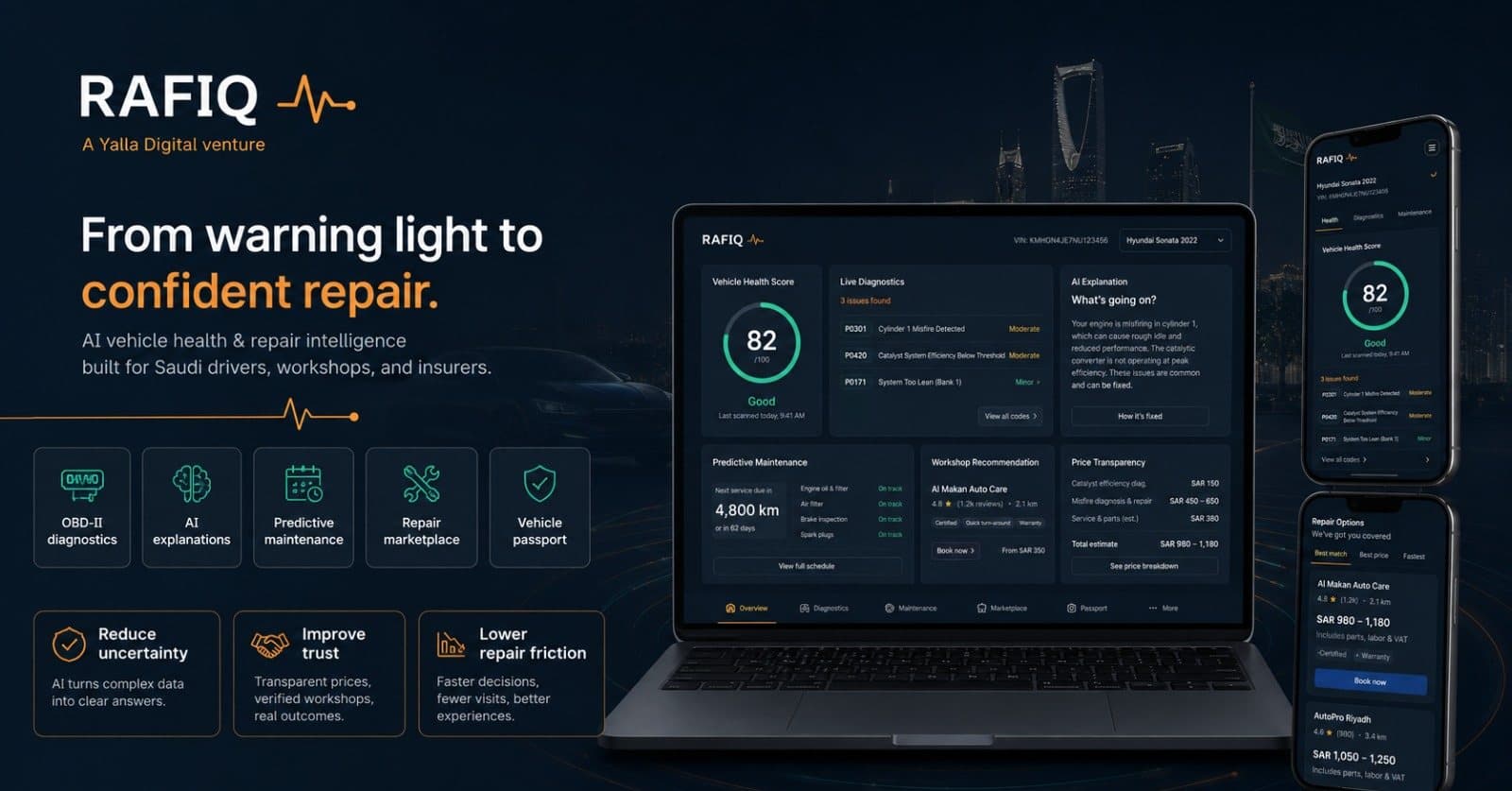
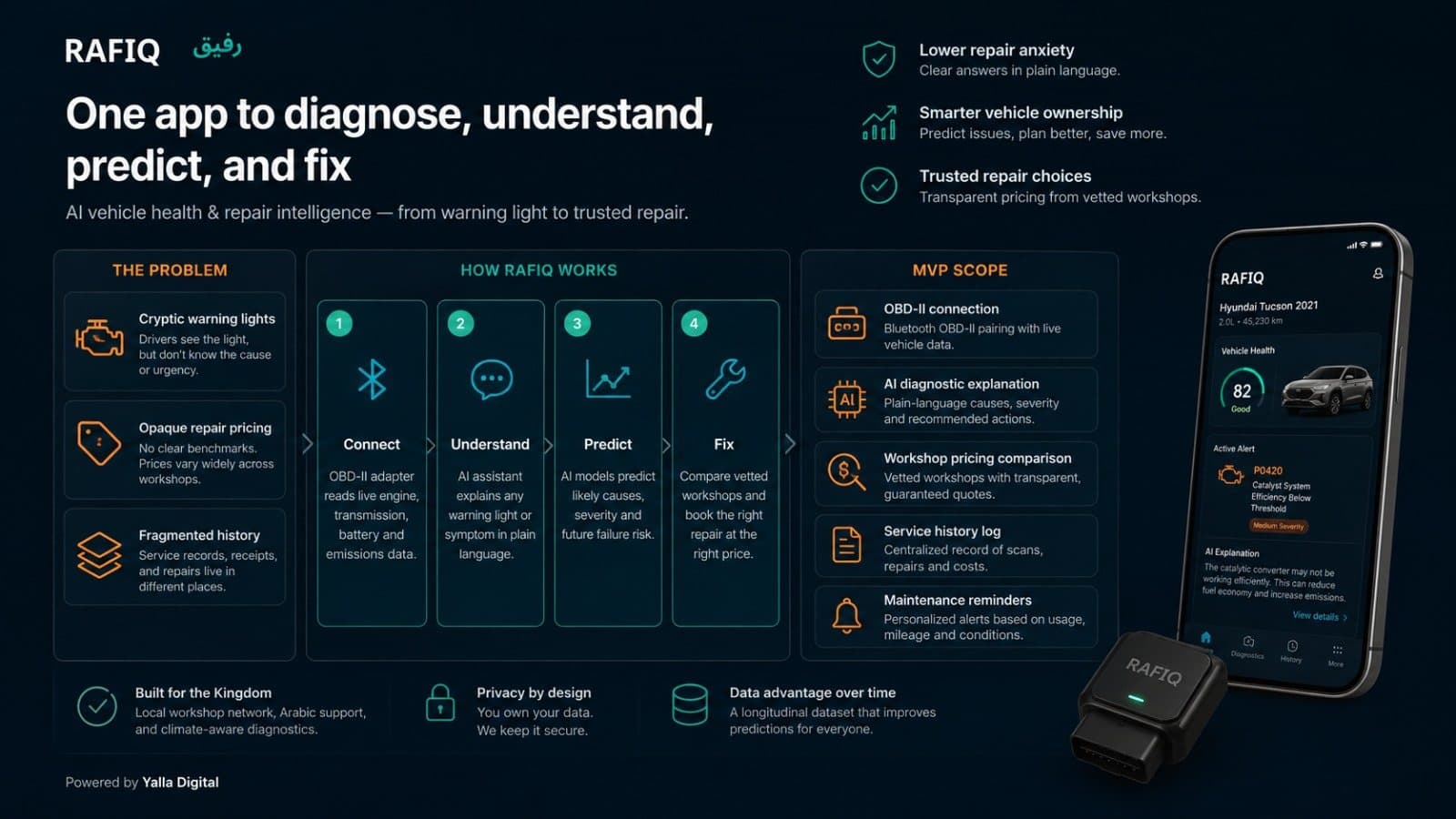
Car ownership has data, but not clarity.
A dashboard light means nothing to most drivers. OBD readers return raw codes, repair marketplaces skip diagnosis, and the owner absorbs both the uncertainty and the price risk.
- Cryptic warning lights
- Drivers see the light but not the cause or the urgency.
- Opaque repair pricing
- There is no clear benchmark, and quotes vary widely between workshops.
- Reactive maintenance
- Problems are handled after failure rather than predicted from use and climate.
- Fragmented history
- Service records, receipts and repairs live in different places and rarely follow the car.
The wedge
Read the car over a standard adapter, explain it in plain Arabic or English, and hand the owner one trustworthy next action.
What it is, and what is actually in the first release.
- RAFIQ Scan
- Standard OBD-II reads over a Bluetooth adapter: supported DTCs and live PIDs.
- RAFIQ AI
- Plain-language explanation of faults and symptoms, with severity guidance.
- RAFIQ Predict
- Wear modelled against service schedules, climate stress and driving patterns.
- RAFIQ Care
- Workshop discovery, quote request and booking.
- RAFIQ Passport
- Vehicle service history and repair evidence that follows the car.
- RAFIQ Partner
- Workshop-side tooling and B2B distribution.
In the MVP
Arabic and English mobile app
Bilingual from the first release, not translated later.
OBD-II connection
Off-the-shelf BLE adapter, supported DTC reads and live PIDs.
AI explanation & severity
Plain-language cause and recommended action.
Workshop discovery & quotes
Vetted workshops, quote request and booking.
Vehicle passport
Repair evidence and service history against the vehicle.
Planned, not built
Predictive maintenanceNext
Failure-risk modelling from usage and climate.
Workshop SaaS and B2B distributionRoadmap
Partner tooling, fleets, dealerships and insurers.
Scope boundary. The MVP reads standard OBD-II data over an off-the-shelf adapter. It does not claim OEM-level diagnostics, and it does not write to vehicle systems.
Who it is for.
- Primary buyer
- Individual vehicle owner
- Primary users
- Drivers, with workshops on the supply side
- Economic buyer
- Consumer subscription first; fleets, dealerships and insurers later
Designed for Saudi driving conditions
Extreme heat and dust shorten the life of batteries, air conditioning and tyres on a schedule no global maintenance table accounts for. Add a large and growing vehicle base, an Arabic-first ownership experience and a fragmented repair-trust landscape, and Saudi Arabia is the right design market rather than a later expansion.
The opportunity, with the arithmetic visible.
Published statistics and our own models are labelled differently, on purpose.
Saudi market signal
15.8M
registered and roadworthy vehicles in Saudi Arabia at end-2024
Saudi vehicle registration statistics, 2024.
~1.03M
new vehicle registrations in 2024
Saudi vehicle registration statistics, 2024.
Illustrative market model
15.8M
TAM base: vehicles in the Kingdom
Registered roadworthy vehicle base used as the addressable ceiling.
~6M
SAM: target compatible and urban vehicles
Vehicles judged OBD-II compatible and in serviceable urban use. Management assumption.
500K
SOM: monetised vehicles by year five
Management assumption on reachable paid penetration by year five.
~SAR 4.55B
Modelled annual revenue ceiling
15.8M vehicles × SAR 288 annual subscription-equivalent value. A ceiling, not a forecast.
The vehicle counts are published registration statistics. The SAM, SOM and monetisation assumptions behind the revenue ceiling are management assumptions and have not been validated by primary research.
How it earns.
- Consumer subscription
- Freemium with paid tiers.
- SAR 19 – 39 / month
- Repair marketplace
- Commission on repair work booked in-app.
- 10 – 12% take rate
- Workshop SaaS
- Tools for vetted partner workshops.
- SAR 499+ / month
- B2B2C
- API and seat contracts with fleets, dealerships and insurers.
- Annual contract
Concept-stage commercial model. These are the price points the business is being designed around, not proven pricing and not an offer.
Targets the business is being built toward.
SAR 24 / mo
Blended paid ARPU
Modelled across freemium and paid tiers at scale.
78%
Subscription gross margin
Software margin target at scale, excluding hardware.
SAR 120
Paid-user CAC
Blended acquisition cost per paying user.
≤ 3% / mo
Paid churn by month 18
Monthly paid churn target once the product loop is established.
~SAR 624
Gross-profit LTV
Modelled at the 3% monthly churn target.
5.2×
LTV / CAC
Derived from the LTV and CAC targets above.
Every figure above is a forward-looking management target for a pre-product company. None is a historical result, and none has been observed in operation.
The vehicle-outcome graph
Signals become symptoms, symptoms become decisions, decisions become repairs, and repairs become outcomes. That longitudinal record across vehicles and climates is the defensible asset, and it has to be earned from real usage. It does not exist on day one, and we do not claim it does.
- Longitudinal history that follows the vehicle, not the owner
- Saudi and GCC operating context: heat, dust and duty cycles
- Workshop network effects on the supply side
- Arabic-first diagnostic language in a market that lacks it
- Designed to compound with every completed repair
Trust architecture
- Read-only vehicle access. RAFIQ does not write to vehicle systems
- Safety-adjacent advice is bounded: severity guidance, not repair authorisation
- The owner controls their vehicle record and who may see it
- Workshop quality and dispute handling treated as an operations problem, not just software
These describe how the product is designed. They are not certifications held.
Wedge first. Platform second.
- NowConcept validation with drivers and workshop partners
- NextMVP: adapter pairing, supported fault reads, explanations, workshop booking
- ThenPredictive maintenance modelled on climate and driving patterns
- LaterWorkshop SaaS and B2B distribution through fleets and insurers
Independent company. Shared advantage.
RAFIQ inherits the Yalla Digital foundation of product, engineering, AI and data, integrations, cloud, security and Saudi commercial strategy, rather than rebuilding it.





Sources & assumptions
- Vehicle base
- 15.8M registered and roadworthy vehicles at end-2024; approximately 1.03M new registrations in 2024.
- Economics
- Yalla Digital internal model, 2026. Forward-looking management targets, not results.
- Excluded
- Global market-size estimates from earlier material were withheld: the source itself flagged them as unverified.
Forward-looking figures are management targets and planning models for a pre-revenue company. They are not historical results, and no customer, revenue, pilot, partnership or certification is claimed anywhere on this site.